Pages

Friday, March 7, 2014

The Secret to Everyday Success


I just want to share some simple thoughts with you today about everyday success. Now I know what you’re thinking: this is going to be about being studious, going to bed on time, eating right, not procrastinating, and pursuing your education. Let’s be honest: that’s has been done a million times already. I’m not going to put you all through that again. Instead, I’m going to focus on an area that sometimes gets overlooked when we consider our success and our education.

Success starts with you. If you want to be successful in college and successful in life, you must choose to have personal success every day. I’ve been going to college for over four years, and I just want to share some things with you that motivated me to move forward when I felt discouraged, overwhelmed, and unmotivated.

I’ve discovered that there’s a key to everyday success. It’s not checking everything off your checklist, it’s not getting your assignments in on time, and it’s not eating three balanced meals a day (although I don’t discourage any of those behaviors). The key to everyday success is not happiness. It is choosing happiness. I know that sounds incredibly simple, but it’s true. Success begins with you—it begins with how you choose to view yourself, your situation, and your outlook on life. This was a truth that I learned at a critical point in my life, when I believed that circumstances created my mood. Bad days equaled sadness. Good days equaled happiness. And so on.


Let me let you in on something. Happiness is a choice. Yes, there are times when our circumstances naturally make it easier for us to feel good about ourselves and our day. But if we depend solely on circumstances to make us happy, how are we going to be successful when we feel bombarded by exams, rainy days, loss, and depression? One of my favorite quotations by Vivian Greene says, “Life's not about waiting for the storms to pass... It's about learning to dance in the rain."

Some of you may be thinking, “You don’t understand what I’m going through. It’s impossible to be happy. I feel so overwhelmed.”

And you know what? You’re right. Nobody will ever understand the exact pressures, struggles, and feelings that you face every day. But that does not change the fact that happiness is a choice you make. 

Pretend that at the beginning of your life, you were standing in a hallway with two doors. If one door represented a lifetime of happiness and the other door represented a lifetime of misery, which door would you walk through? I don’t believe that any of us enjoy being miserable. In fact, I think there would be a stampede for door #1. If you could choose happiness that simply, then why do you deny yourself happiness in the present? I know that making the conscientious choice to be happy each day takes a lot more effort than simply walking through a magical door, but the principle is the same. The only person who can deny you happiness is yourself.

So how can you have everyday happiness? There are two ways that have effectively helped me. The first is incredibly simple and perhaps even predictable: be thankful for what you have. Look at where you are right now—reading this post via computer or iPhone. Simply having access to the internet is a blessing in itself. Where are you reading this from? Likely a building of some kind—perhaps your home, perhaps your college, perhaps your workplace—all of which are blessings in themselves. And that’s just looking at this present moment.
None of us have perfect lives. Each of us has our own battles and struggles and difficulties. Some of us struggle with depression, self-esteem, fears, anxiety, and uncertainty. But next time you have to force yourself to get out of bed in the morning and greet a day that you’d rather just sleep through… remember that you were able to literally get out of your bed in the first place. There are a lot of people who have never been able to walk who would give anything to be able to stand on their own feet.

Being thankful is one of the most important keys to happiness at your disposal. Challenge yourself to be thankful for something different each day. Even in your darkest moments, there is something monumental to be thankful for—the clothes on your back, the strength in your body… Even if you lived from now until the end of time, you could never run out of something new to be thankful for each day. That is one of the greatest keys to happiness.

The last point I want to leave you with is what I believe is the second key to happiness—thinking outside yourself. The world as you perceive it is only as large as the individual lives that you care for. If you think only of yourself, your world will be defined by that, and it will become a small, overly-involved cycle of pursing endless self-fulfillment, only to find semi-satisfactory results waiting at the end. When you choose to think of others, your horizons expand. You begin to see the world from more viewpoints than your own, and it becomes a beautiful place.

When we worry, feel overwhelmed, depressed, or bitter, we become self-consumed. We focus inward and forget that there is a beautiful world surrounding us, filled with people that we can impact. Think about how many people you encountered today. What kind of interaction did you have with them? Even if you made the smallest contact with them, you have had some small impact on them and shaped their day in some way. You offer a piece of yourself to every person that you meet. What impressions do you give? What impact do you have?

Always think of others. Strive to do at least one selfless thing a day—whether it’s sending someone an encouraging text, complimenting someone, donating to someone in need, or volunteering. When you help others succeed, you help yourself succeed. If you are feeling discouraged and hurt, and you choose to show kindness to another person, you are doing one of the strongest things you possibly could. You are acting against your nature to nurse your own hurts and choosing to focus on someone else. That takes great strength and it says a lot about your character.

In order to have a successful future, you must choose to make everyday a success. You will not always succeed, but facing and overcoming failure will be a greater part of your success. Demand your right to fail. Accept the challenge that failure poses, and choose to pursue your dreams and education regardless. Because if there is no chance of failure, success is an empty, meaningless thing.
Make everyday a success. Choose happiness. Find something to be thankful for each day. Do a small act of kindness for someone each day.

The future is yours. 

Embrace your dreams.


Saturday, February 22, 2014

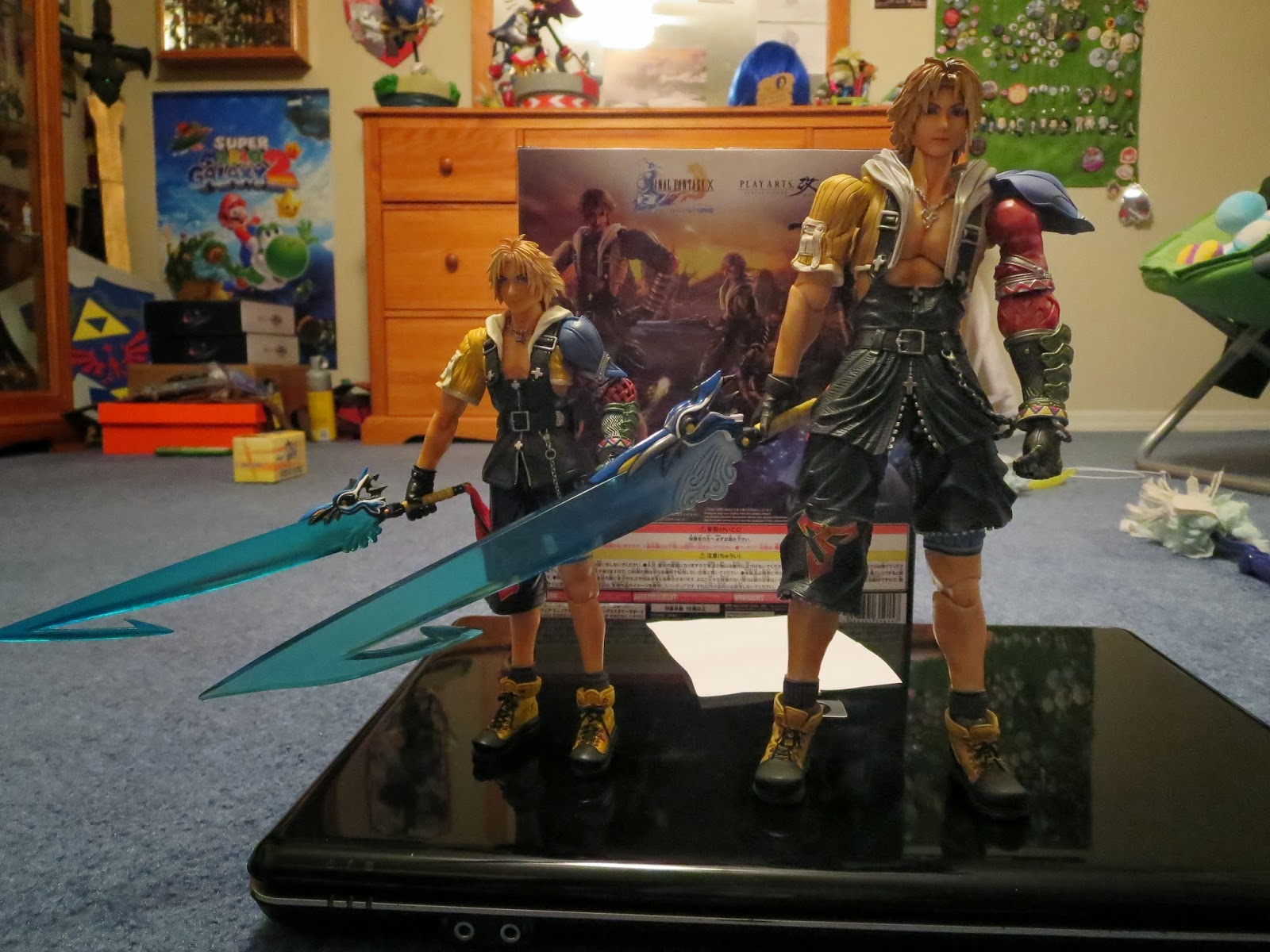
Action Figure Review: Tidus and Yuna Play Arts Kai


"Listen to my story. This… may be our last chance." ~Tidus, Final Fantasy X

Please enjoy listening to this nostalgic music as you read this review.

Packaging: Following the new Kai Arts packaging, both Tidus and Yuna come in detailed, colorful boxes with snap-open Velcro clasps. The box art is gorgeous and attractive. The insides contain explanations on the characters and series (reminiscent of the narrator in Dissidia, if you ask me). Props on the packaging, SQUARE!


Paint job: Really lovely, especially when you compare them to their previous figurine releases. For example, Tidus has much more shading this time around, which gives him a more realistic, dramatic look. The skin tone has multiple shades to it, which is much more attractive than the single color used in the first Play Arts line. I noticed just one or two very minor paint smudges. The paint job gives an impression of maturity, as these figures are becoming more lifelike in their details.

The new Play Arts Kai Tidus (right) next to the older, original Play Arts model (left)
Articulation: Tidus boasts of very thorough articulation. In fact, the only two areas that are not flexible are his hips and his left wrist, which is restricted by sturdy upper-arm armor. Otherwise, almost all other locations are flexible—neck, shoulders, chest, legs, ankles, bottom of the shoes, shoulder guard, etc. Admittedly, the chest rotation looks slightly awkward as it misaligns his vest straps.


Yuna is more restrictive. While still graced with a reasonable flexibility, her legs in particular seem to suffer. Unlike Tidus, the bottom of her boots is not a separate piece, and there is no side-to-side movement allowed by the ball joints in the ankles. Because of this, getting Yuna to stand up (especially if you get a figure with a slightly crooked shoe base) can be a bit tricky without a stand. The wide sleeves of her garb sometimes restrict how much her hands are able to turn at the wrists as well.


Accessories: Tidus comes with Brotherhood (which is almost as tall as he is), his Blitzball, an exchangeable face with the eyes closed, and three additional hands: (1) an open palm for holding the Blitzball, (2) a gripping hand for holding the sword, and (3) a slightly open hand for simple visual diversity.

Yuna comes with a slightly more modest variety: two open hands, an interchangeable face with the eyes closed, and her rod. She arrives with her closed-fist and staff-holding hands attached.

The figures each come with the new Kai Arts line stands. These new stands are bulky and transparent. They require assembling and, from my personal experience, just aren’t as effective as the classic black-stands-with-metallic-cinches were. They’re a hassle to put together and they take up a large area of your shelf. The figures can balance just fine without the stands, fortunately, making the stands pretty unnecessary for these two (unless you want to give them a very dynamic or unbalanced pose).


Negatives: Tidus’ sword-holding hand is loose, which on the one hand makes it easy to slide the sword into his grasp, but on the other hand makes it easy for the sword to slip back out again. Certain areas are not flexible, particularly the left wrist. His necklace and pendant are sculpted directly into his neck, unlike the previous Tidus figure, whose pendant hung loosely from his neck by a delicate chain. Something about the proportions between his head, neck, and chest seem a bit… off… but perhaps this is due to the fact that the open vest makes his neck look longer. Lastly, he can only hold his props in his right hand, meaning that you can’t pose him to hold both the sword and the Blitzball simultaneously.

Yuna suffers from some inflexibility in her boots, which can make posing her slightly difficult. The fingers on her open hands are very delicate and should be handled with caution. The wide sleeves of her garb can restrict the rotation of her wrists. 


Overall: Rejoice, fans of Final Fantasy X—these are the figures you’ve been waiting for! SQUARE is kicking off the release of Final Fantasy X HD in style, and these figurines are the perfect way to commemorate your love for the occasion. Giving these figures an overall rating is difficult. In comparison to their previous Play Arts figures, this newer Tidus and Yuna truly shine with more articulation, a better sculpt, more realistic shading, plenty of accessories, and a snazzy paint job to top it all off.

As independent figures, these two lovebirds are impressive pieces to add to your collection. Due to some of the negatives listed above, however, they aren’t flawless. For the fan, the imperfections won’t matter, though. You’ll be too busy reliving nostalgic memories of Spira and the tears you shed during that last, glorious CGI cutscene.

I’m proud to give the new Tidus and Yuna Play Arts Kai figurines 4 out of 5 stars.


You might also like:

Monday, February 17, 2014

Phoenix Wright: Ace Attorney—Dual Destinies Rubber Phone Strap Collection Review


Packaging: The box is colorful and attractive. While you likely won’t want to keep these little guys imprisoned in their boxes very long, the set comes nicely—and securely—packaged for storage and selling purposes. Each figure is stored in a smaller “blind” box, meaning that you don’t know which figure is packaged in each one. Don’t worry, though—each collection contains one of each figure, meaning that you get the full set.
 
If that trademark cowlick doesn't give away the "mystery" figure, then I don't know what does.

Phone Straps: There are six figures included in the set: Phoenix Wright, Athena Cykes, Simon Blackquill, Bobby Fulbright, Apollo Justice, and Miles Edgeworth (the not-so-obscure “mystery” figure). These little guys have a rubbery texture, making them soothing to the touch. If literally used as phonestraps or keychains, they could eventually become soiled by fingerprints and pocket lint, however.

Each character is rendered adorably and the attention to individual character detail is—simply put—charming. Simon has a chibi-fied Taka perched on his shoulder, for instance, and it’s hard not to smile at mini-Worth’s cute glare of lawyerly severity.


Negatives: If I had to nit-pick, I could only say that most of these guys look pretty unhappy. Phoenix is wearing a rather dangerous expression, which is a bit out-of-synch with his easy-going attitude. As this is meant to capture the spirit of Dual Destinies, however, I can see why the crafters chose to lose the potential smile in favor of his new character artwork.


Overall: It’s a bit trite to say “what’s not to love?” about these little guys, but that’s the fact here. These phone straps are solid, Dual Destinies collector’s items for fanboys and fangirls of the game. It goes without saying that if you have the other sets, then these belong in your collection too. They aren’t exactly the line of action figures I was hoping to see spin from this title, but they work quite well as a substitute. Verdict: 5 out of 5 stars (NOT GUILTY!)


Sunday, February 16, 2014

The Psychology of Writing: 5 Tips for Writing Chair-Gripping Suspense


Some of us love surprises. Others would be mortified if their friends threw them a surprise birthday party. Regardless of your stance, however, you can’t deny that the element of suspense plays an important role in our lives. Few things peak our interest like the thrill of the unknown.

Likewise, few things draw readers into a story faster than suspense. Whether you write mystery, thriller, supernatural, or fantasy, no genre is untouched by some element of suspense. Below are five simple tips that can help you craft hair-raising, page-turning apprehension.

1. The Power of Imagination and the Unknown
Growing up, our imaginations were almost always active. We were very good at “pretending” to be things we weren’t and played with our imaginary friends. However, this imaginative power could also take the form of monsters and other less favorable creatures that lived in our closets at night. Even as adults, several years later, an unexpected bump in the night can send our hearts racing.

This natural fear of the unknown is basic suspense at its finest. If you hear something strange, or catch a fleeting glimpse of a shadow, your mind instantly strives to discover its origin (and often comes up with several frightening options in the process). The versatile imagination that you developed as a child continues to feed your brain with possible, and often far-fetched, answers to the unknown things around you.

When you write suspense, use the power of the unknown. Shadows aren’t frightening if you reveal what is casting them. If something, or someone, is stalking your main character, for example, don’t reveal who or what it is. Keep your readers in the dark. Suspense is only suspense until you know the source of it. Once you reveal the source of the suspense to your readers, it ceases to be suspense. At this point, it may take another form—horror, relief, or perhaps even a new form of suspense—but the original suspense that you built up will have dissipated.  

2. Fulfill your Promises
Sometimes suspense is not as literal as a “bump in the night.” Sometimes it’s a long-term unknown.

In The Scarlet Letter, for example, a sort of long-term suspense runs throughout the length of the novel: will Dimmesdale be found guilty of adultery? Will Chillingworth find out Dimmesdale is guilty? A lot of this suspense stems from the fact that Chillingworth has sworn to find his adulterous wife’s partner-in-crime. The author has promised the reader that Chillingworth is set on finding the truth, and his vengeful nature could cause several consequences for Dimmesdale, should he be found out. Once the author makes a connection between Chillingworth’s desire for revenge and Dimmesdale’s guilt, the reader is given a promise of ominous things to come. The result: long-term, page-turning suspense.

To create effective, long-term suspense, it is important to make promises to your readers. But it is even more important to fulfill those promises in a more-than-satisfactory manner.

For example, if you promise your readers that your villain is a master thief who is willing to go to any length to procure treasure, then you had best fulfill that promise. Put him in the middle of his greatest heist. Show off his desperation—or his ruthlessness—in getting past all those who stand in his way.

A promise isn’t usually something that you alright state to your reader. It is something that you hint at through your plot, characters, and dialogue. Most importantly, though, don’t let your readers down. Fulfill their expectations and exceed them if you can. It will keep them coming back for more, and you will have gained their respect for having their best interests in mind.

3. Lead, then Mislead, then Lead Again
How many times have you read or watched a scene where one character is hiding from another? 

Usually, it goes something like this:
(1) Character A hides behind something as Character B comes in looking for them.

(2) Character A holds their breath and freezes as Character B paces around the room.

(3) Character B freezes and regards Character A’s hiding spot.

(4) Character A prepares to panic, but just as the tension is about to break Character B decides there is nothing of interest and moves on.

(5) At this point, Character A may be in the clear, but oftentimes Character B will double back and discover Character A’s hiding place after all.

Sound familiar? This creepy hide-and-seek game is an oft-used scene of classic suspense. But what I want you to notice in this example is not the literal “hide-and-seek” match, but the principle that is at work here. The Lead-Mislead-Lead (or MLM) principle says that keeping your readers guessing is the key to golden suspense. Like a teeter-totter, this concept reels unsteadily between one outcome and another. This leaves your reader cringing as the balance tips first one way, and then another, uncertain which outcome will occur.

Of course, the “hide-and-seek” example represents this principle at its most basic level. A great example of this concept occurs in the film The Lord of the Rings: The Return of the King. The battle for Minas Tirith wages relentlessly back-and-forth: Mordor attacks the city, the city retaliates, Rohan arrives to reinforce the city, an army of Mumakil arrive to reinforce Mordor, an army of undead warriors arrive to reinforce the city, etc. The battle becomes a heart-stopping balance where evil prevails one moment and good triumphs the next. This uncertainty creates tremendous suspense, which keeps the viewers tuned in to the on-screen action.


4. Alternate Between Short and Long Sentences
Sentence length is key to setting a suspenseful mood. Shorter sentences are generally used to create quick images that convey action, fear, or sensory input. Longer sentences can convey moments of false calm, contemplation, or uncertainty. To get the most power out of your suspenseful moment, it’s important to alternate between these two sentence types. Here is an example:

Elena forced her shaking limbs to be still. Hidden beneath the table in the deserted training room, every breath sounded like a geyser rushing from her lungs.

A heavy foot creaked against the floor. Closer now. Another step. Another. She could hear the rattled breathing of her foe as it prowled the grounds, searching.

Silence.

She locked her eyes shut. The creature sniffed for her scent. One more step and its claws would find her.

5. Focus on the Senses
Think back to a time when you felt you were being watched. Maybe something startled you. Maybe you were extra paranoid because you were alone. Relive that moment. What did you focus on visually? Your attention likely shifted from shadows to low foliage or other places where something could hide unnoticed. What startled you? It may have been leaves scraping on the sidewalk, the scurry of a small animal, the shadow of a bird flying overhead, or something else.

Regardless of the circumstance, looking back at your own tense moment, you will realize just how perceptive your senses became. The fear of the unknown likely triggered your flight-or-fight response, which enhanced your vision, hearing, and overall sensitivity.

When you write in-the-moment suspense, especially from a first-person viewpoint, pay close attention to what your character is sensing. All of your character’s senses should be sharpened by the uncertainty of the moment. Be sure to hone in on those and weave them into your scene as necessary. These details will add to the realism and credibility of your suspense.


The Best Advice? Read, View, and Practice!
The best advice I can give anyone who wants to write suspense is to saturate yourself with suspense. Try a variety of mediums. Pick up the latest thriller from a popular author. Watch an old “who-dun-it.” Play a first-person video game like Slenderman. Listen to suspenseful sound effects and music. Recall a personal experience that triggered your flight-or-fight response and put it into words.

 
And, most importantly, practice. Write, edit, rewrite, repeat. 


And keep an eye on the shadows.