Pages

Sunday, January 19, 2014

5 Tips for Writing Action-Packed Fight Scenes


Conflict is vital to every story. 

And often, that conflict escalates from disagreement and dislike to physical combat. In the world of fiction—especially genres such as fantasy and sci-fi—writing satisfying, dynamic fighting sequences is often a necessity.

Let’s take a deeper look at the adrenalin-laced topic of fighting, as well as a few tips that will help you write more dynamic, intense battle scenes in your stories.

1. Actions VS Reactions
At its core, the most basic rule of combat follows Newton’s law of motion; namely: “To every action there is always an equal and opposite reaction.”

To keep things simple, think of physical combat as a game of chess. One player makes a move, which causes the other to react to the move in some way. Of course, physical fighting is much more complex, but the principle is the same. When one combatant throws an attack, the other must either return the gesture offensively (by attacking back) or defensively (by protecting themselves). This aggressive “give-and-take” is what makes fighting flow.

When you write action scenes, remembering this basic principle can help simplify the task. When more than one combatant is involved in the fight, the possibilities are greater, but the law of actions VS reactions remains the same. Here is a basic example of one-on-one combat from Redwall by Brian Jacques. Notice the specific actions that the combatants take and how their foe reacts to them:

The thick tail of the Warlord [Cluny] flicked out venomously at Matthias’s face. He covered swiftly with his shield as the poisoned metal barb clanged harmlessly off it. Cluny tried again, this time whipping the tail speedily at the young mouse’s unprotected legs. Matthias leaped nimbly to one side and swung the sword in a flashing arc. Cluny roared with pain as it severed the tip of his tail.

2. Universe, Setting, and Atmosphere
What is the setting of your story? Depending on that answer, the combat options available to you will change. It goes without saying that a story set in medieval times will not see much gun-fighting. Likewise, characters in the prohibition era won’t likely be garbing up in armor and swinging their sabers into battle.

Those are both silly examples, but knowing exactly what is available to you in the setting of your story is important. If your story takes place in a fantastical world where characters use both swords and firearms (think: Starwars), then it’s important for you to understand the laws of these weapons. What advantages do certain weapons have over others? How do they operate in battle? Do they have any special abilities or uses? And so on.

Atmosphere is key to producing a tight-paced, innovative action sequence. Exactly where the battle takes place can alter the style of the fight, so choose interesting locations with lots of potential for creativity. More importantly, use the atmosphere of the fight to add tension and immersion to the fight. For example, if your battle takes place inside a cathedral, have your characters utilize the pews for barriers and platforms, use a candelabrum as a weapon or to set something on fire, or even jump on-board a massive, rocking chandelier for some high-flying, reckless combat. Mention the way that the sounds of combat echo through the rafters, or how the stained-glass windows cast crimson light down on the combatants. The possibilities for adding to the atmosphere of a battle are as boundless as your own creativity.

Each universe has its own set of rules, and depending on those rules, the style of your combat will vary. In some universes, gravity has little effect, making battles much more open with many more possibilities. Battles involving magic or other such super powers have their own set of rules, as well. Choose atmospheres that allow your combatants to utilize their special powers in unique ways. The TV series, Avatar, demonstrates this principle quite well, in that it uses atmosphere in order to create unique battle fields with every fight. For example, a character who can manipulate—or “bend”—water must have some source of water in order to fight. In the show, a “water-bender” may find themselves in a variety of unique fights in which they must use their powers in innovative ways, such as by bending a tidal wave from the ocean, freezing water into ice pellets, absorbing water from snow, or even using their own sweat as a weapon.

3. Even the Odds
Much like the story’s plot, a fight is not enjoyable to read if it is predictable or one-sided. There will be times when your combatants will not be evenly-matched, and these battles will end quickly and unceremoniously. However, for a lengthier, more engaging fight, both opponents will need to have evened odds. This does not mean that both characters must be equally matched. It simply means that the “weaker” character must have some form or chance of winning against the stronger opponent. The “weaker” character may be able to use the atmosphere to get an advantage, have an animal companion that assists them in combat, or perhaps have a temporary benefit because their enemy is weakened or wounded, etc.

Unless your character is designed to intentionally have god-like powers, it’s a good idea to have both characters take injury at least once in order to show that they both have a chance at winning. This also helps to make your heroes and villains realistic and generally assists with avoiding the “over-powered god-character” stereotype. Remember that, with battles, you don’t want to be too predictable, but you do want to be believable. If you want the underdog character to win the fight, then come up with a believable, creative way for them to win. Chances are that they will not be able to conquer their foe through brute force or whatever fighting technique their opponent has mastered. In Redwall, the hero conquers the villain by cutting away the rope of the abbey bell and having it crash down on the villain. Even through the hero is unable to defeat the villain through outright strength, he uses his cunning, and the atmosphere of the battle, to his advantage and triumphs in the end.

4. Visualize
It is impossible to write anything without some form of visualization; however, when you pen, or type, a battle sequence, this visualization is incredibly important.

What does your battle look like? Try to see it in HD detail. Visualize everything. Notice the smallest details—the shadows, the fabric of your characters clothes, the exact patterns and colors of the magical attacks involved, the light flashing along the swords… It’s a lot to keep up with, but with fighting scenes it’s important to visualize what’s going on. Otherwise, you might end up writing a combat sequence that doesn’t flow.

Is your combat realistic? Wearing a billowing cape into a one-on-one duel may not be the brightest idea, even if it does make for some rather dramatic descriptions. Does your character really need to backflip over a bench in order to avoid that attack? Better yet, is it possible to backflip while wearing all that armor? Granted, your characters may be incredibly agile. They may be ninjas or mages who are capable of maneuvers that regular fighters couldn’t hope to pull off. If this is the case, then know what physics and rules apply to their style of fighting and ensure that their combat remains within believability.

5. Seek Inspiration
One of the absolute best things you can do to enhance your battle-writing skills is to read, and view, battles. Pick up novels with detailed, stimulating action sequences, such as the works of Brian Jacques or R.A. Salvatore. If you enjoy movies, watch The Lord of the Rings, Avengers, The Legend of Korra, or some other action film that matches the genre of your story. If video games are your thing, take a look at the Final Fantasy series for some intense, CGI combat. Regardless of the genre you write, there are many wonderful media options available for your viewing pleasure. Here are some things to look for as you view an action sequence:

  • How do the characters use the atmosphere to their advantage?
  • How does the atmosphere add to the drama or uniqueness of the battle?
  • Do both characters take injuries of some kind?
  • Does one character appear to have the advantage? How does the “weaker” character compensate for this?
  • How are the physics and/or systems of the world implemented into the battle (magic, physics, super-powers, shields, etc.)?
  • Is victory achieved? Is it achieved through outright force, or through some other compensation?
Music is another stimulating way to unlock your inspiration. Seek out thrilling, engaging soundtracks and visualize the combat happening in time to the music. You might be surprised with how many ideas you are able to generate with this method. For some epic, inspiring music, I recommend checking out Immediate Music, Two Steps from Hell, and Audiomachine, to name a few. Trailer music and movie scores are both excellent sources of inspiration for wide-sweeping battle scenes, and I highly recommend listening to some as you brainstorm your combat sequence.

Monday, January 13, 2014

Four Quotations from Gandalf that can Teach Us about Writing


Perhaps no other character in the Lord of the Rings trilogy offers more memorable, oft-quoted wisdom than the wizard Gandalf. Mysterious, independent, and occasionally short-tempered, Gandalf’s name has become a byword for sage-like mentorship. 

And, as with all true wisdom, the words of Gandalf can be applied to everyone—not only to young Hobbits and kings-to-be, but also to those who take up the pen in place of the sword. Let’s look at four quotations from Gandalf and apply them to the business of writing.

1. “Do you wish me a good morning, or mean that it is a good morning whether I want it or not; or that you feel good this morning; or that it is a morning to be good on?” ~Gandalf, The Hobbit

Upon seeing Gandalf, Bilbo makes the mistake of wishing his wizard friend a “Good morning,” to which Gandalf replies with this quote. And while this may seem like mere clever banter on Gandalf’s part, there’s actually a good reminder to us writers therein.

What do your words mean? Remember, words have different meanings and word-pictures for everyone. Even a word as simple as “cat” will create a completely unique image in every individual’s mind. One person may think of their tabby cat from childhood. Another may imagine the mangy, alley cat that yowls on the fence every night. A third may think of an independent, or aloof, creature that sharpens its claws on furniture.

So, what do your words mean? That’s up to you to determine. If you want your reader to picture the cat in your story as cuddly and loving, be sure to reflect this fact. It may be that a particular reader has had a bad experience with cats or simply doesn’t like them. In this case, it is your responsibility to portray the cat as you want your readers to see it. Use words, but more importantly, use actions. Show that this cat is a creature worthy of your reader’s admiration. Perhaps it keeps its owner warm on cold nights or is a therapeutic cat that brings cheer to hospitalized children.

Keep in mind, too, that ambiguity can confuse your readers. In Gandalf’s example, “Good morning” could mean any manner of things. It’s your responsibility to determine which one of those things you want your readers to know and understand. Here is a simple example of ambiguous reference: “Gandalf told Frodo that he would take the Ring to Mordor.” The question on your reader’s mind right now is: “Who is he referring to? Frodo or Gandalf?” Is Gandalf telling Frodo that Frodo is going to take the ring to Mordor, or is Gandalf saying that he is going to take the ring to Mordor? This may seem like a small nit-pick, but it makes an enormous difference to your readers’ understanding of your story.

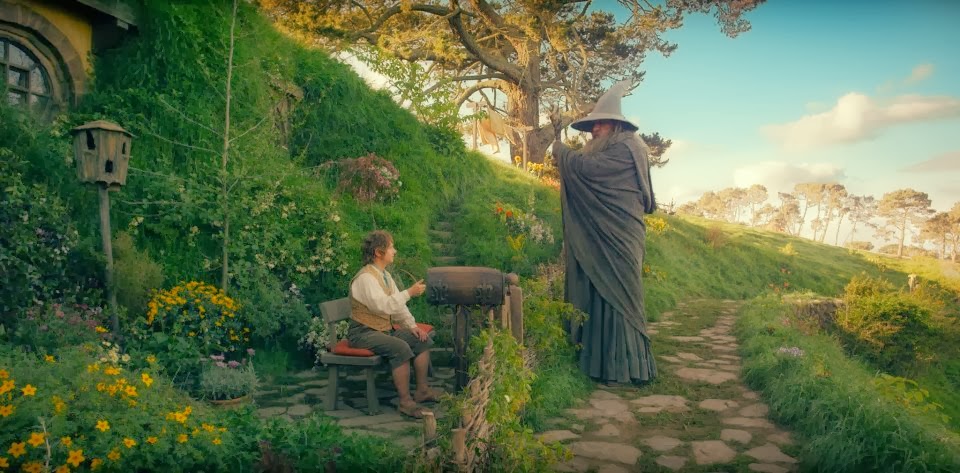
2. “You've been sitting quietly for far too long!” ~Gandalf, The Hobbit: An Unexpected Journey

In the film adaptation of The Hobbit, Bilbo—rattled by his experience with the dwarves who have pillaged his home—finds a private place to sit and collect himself. “I just need to sit quietly for a moment,” he tells Gandalf.

To which Gandalf retorts: “You’ve been sitting quietly for far too long!”

Bilbo has lost sight of what once was—his youthful sense of wonder and joy—and replaced it with the mundane business of life. He has let other things get in the way of his natural curiosity and his love for adventure and dreaming (traits which Gandalf claims Bilbo possessed as a boy).

Much like Bilbo, writers sometimes fall into this rut of being too busy, or too preoccupied, to spend even a small amount of time doing what they know they love—writing. It is not always easy to dedicate time to writing, but if you love the way your words weave together—if you find satisfaction in creating imagery and composing stories—then writing is what you were meant to do.

Taking a break from your work is a good—and healthy—practice. However, if you avoid writing because of fear, laziness, or “writer’s block,” then it is time to jump back behind the laptop, notebook, or typewriter, and start weaving words again. This is the only way you will ever make progress—by literally writing something. Sentences don’t form themselves, after all.

Write every day, even if just one hundred words. Like any skill, writing evolves through practice. Continue to write, and your talent and experience can only grow.

3. “For even the very wise cannot see all ends.” ~Gandalf, The Fellowship of the Ring

Some writers like to outline. Others, like Stephen King, claim that outlines make a book staler than those that are written spontaneously.

But whether or not you outline, don’t be afraid to change course. No story—no piece of writing for that matter—will ever turn out exactly as the author intended. Some sub-plot or some new character is bound to crop up half-way through the work, and even the smallest changes can alter the original course of the story.

Don’t let this frighten you. Part of the joy of writing is not knowing where your story is heading. Sometimes re-writing an entire chapter—or an entire work—is the best thing that you can do for your story. In the long-run, your creation will be better for it.

This quotation also serves as encouragement to not give up on your work. Writing is difficult. Good
writing is an art that takes years to master and more than a lifetime to perfect. But the truth is, you do not know where your writing will take you. You cannot possibly predict if, in ten years, you will be at the top of the “Best Sellers” list or inspire a nation with your words. Strive to make your writing the best that it can be, and don’t give up on your dreams. Do not let others discourage you—they can no more see the end than you can. And if you stay true to yourself and your passions, it will be a beautiful end, indeed—an end that you chose to achieve.

4. “All we have to decide is what to do with the time that is given us.” ~Gandalf, The Fellowship of the Ring

This is, perhaps, Gandalf’s most iconic and inspirational quotation. When Frodo expresses that the Ring is too large a burden for him to carry, Gandalf comforts the hobbit with these words.

We are all appointed a specific time to live on this planet, and a specific time to leave it. All life has meaning and purpose, and what we choose to do with our time is very important. We are only given one life to live, and we must live it to its fullest.

If you were born to write, ask yourself what stories you were meant to tell. Then write them. Words can change the world. Your stories, poetry, essays, and manuscripts, are all gifts given to you. It is your responsibility to write them so that others can experience them as well. Use your talents and tales responsibly. Use them to give back to others. Use them to better yourself and your world.

Sunday, January 5, 2014

The Psychology of Writing: What Aristotle can Teach Us about Writing Fiction


When you write fiction, you write an argument.

When I say “argument,” I am not referring to a “battle of wits,” wherein you try to out-smart and out-talk the opposing viewpoint. I use the word “argument” here to mean “an effort through which you strive to prove a point.”

No matter what genre of fiction you write, you write for a reason. This reason may be any manner of things—from self-discovery, to expounding some great truth, to simply entertaining your readers. Regardless of the reason that lies at the heart of your fiction, you must understand that, when you write a story, you write an argument. You write to prove a point.

So, then, this begs the question: how can I prove my point to my readers?

Let us take a moment to look into the research of Greek philosopher Aristotle—one of the earliest researchers of human communication. Through his observations, Aristotle was able to make significant discoveries about the power of an orator’s argument and its effect upon the audience. These same findings can be utilized and applied to fictional writing in order to “prove the point” that you strive to make to your readers.

Logos—the Power of Logic and Consistency
Strong arguments are filled with logos, or the ability to apply logic effectively. When you write fiction, keep your characters and world in mind. Is it natural for your regularly dead-pan character to break out laughing at the telling of some know-it-all joke? Most likely not. But if this is indeed what happens in your story, ask yourself why your character is reacting this way. There may be a perfectly good reason for it, in which case you should strive to logically explain the odd behavior. Maybe the character recently experienced a great fortune and is unusually giddy. Maybe they suffer from a psychological condition which gives them an optimistic “high” at unexpected times. If, however, you decide that the reaction is misplaced, take it out of the story and replace it with something true to the character.
 
Logos is vital to your fictional world as well. If your story takes place in a realistic, Earth-centered environment, be sure to keep that in mind. Your readers will be more likely to expect a logical approach from such a setting because they are more familiar with it than they would be with, say, Middle Earth or some other fantastical place. But if your story does take place in a made-up world of your own imagining, logos still applies. Keep the natural rules and laws of your fictional world in mind. If the land is governed by a “magic system,” for example, don’t break the laws of the magic you have created. Even in the most obscure fantasy worlds, some stream of logic must prevail, even if that stream of logic means that there is no logic at all.


Consistency is equally as important to logos. Ensure that your characters and world follow the rules that you have laid down for them. Anything “out of the ordinary” will be noticed by your readers, and even the smallest inconsistencies will be picked out by those who read carefully. If your character suffers a head injury in chapter seven, but no mention of this injury’s effects on the character are made afterwards, your readers may begin to question the logic and realism of the story you are telling.

Having strong logos means focusing on the small things, as well as the prominent ones. If your story is a chair-gripper, your supporting cast lively and unforgettable, and your dialogue placed perfectly, that’s all well-and-good. But if, at the same time, your main character’s backstory has a detail or two that doesn’t make reasonable sense, it will harm the over-all effect of your story. As a rule of thumb, negative messages tend to linger longer in the mind than positive ones. A little illogical fiction can cause a lot of disenchantment. Give extra caution to all aspects of your story—from the over-arching plot, to the color of your character’s eyes—and ensure that the facts are both consistent and reasonable (if not altogether believable). You want to keep your reader immersed in your tale, so don’t give them any reason to question your reasoning. A logical story—a logical argument—makes for a satisfied reader.


Pathos—the Power of Emotion and Being Relatable
Some are governed by their heads. Others are led by their hearts. While logos focuses on what is believable and mentally acceptable, pathos reaches out to the feelings inside us.

The key to having strong pathos in your writing is generating genuine emotions through your words, characters, and plot. You clearly love your fictional world and the fictional population that inhabits it. You care about your story because it is born from your deepest passions—your beliefs, hopes, dreams, and experiences. Take hold of this passion that you have, and convey it to your readers. The famous saying “Write your first draft with your heart, but edit it with your head” is especially true of pathos. Passion and emotion are catchy things, and if you express joy and excitement through the pages of your fiction—if you pour your heart into your words—your readers will feel those emotions as well. What is written with passion is read with enjoyment.

Be mindful of the pathos you create scene-by-scene and character-by-character. Ask yourself: “what emotions are being portrayed here?” Follow this by asking yourself, “What emotions do I want to portray here?” By ensuring that both questions have consistent answers, you are taking the first step towards achieving successful pathos.

But pathos, like logos, is not something you can simply put your finger on. There are thousands of ways to successfully achieve genuine emotion. One effective way is to make your reader understand your characters’ hearts. What drives your characters? Why do they feel the way they do? Why should your reader care enough to read your story and learn about them?

I find that putting bits of personal experience into my stories helps me express emotion better. If you have been through a frightening car wreck, or experienced the death of a pet, you fully understand what it’s like to experience these traumas. You can write about them from your heart and bring a realistic edge to your writing. Of course, you don’t have to have personal experience in order to write effective pathos, but it can none-the-less be very beneficial to achieving heart-felt emotion.

To sum pathos up in one word, pathos is “care.” It is why your readers should care enough to feel what you want them to feel. Use pathos to guide your readers. Reveal to them who they should care about (or feel positive pathos towards) and who they should not care about (or feel negative pathos towards). Negative and positive pathos work together to guide the reader’s feelings. The stronger the darker feelings are (loss, sorrow, anger, hatred, fear) the more emphasis your lighter feelings (hope, joy, love, celebration) will receive. Balance your pathos and use them to build your story and characters!

Ethos—the Power of Credibility and Fact
Lastly, to truly convince your readers of your “argument,” you must utilize the power of ethos—or thorough knowledge about that which you write.

If your story takes place in medieval England, the NASA space station, or the Prohibition era, be certain that you know your facts. Even if your story is fictional, it is important to have a historically, and culturally, accurate portrayal of your subject matter. Do your homework! Double-check that the facts you use are, indeed, facts. If NASA was founded on July 29th, 1958, don’t make the mistake of writing that it was founded on July 20th, 1958. Most readers may not catch the inaccuracy, but some will. These inaccuracies might, in turn, cause readers to cast doubt on your work, and wonder if other facts in your story might be inaccurate. As a result, they will likely take the rest of your tale with a grain of salt. This harms the overall believability and credibility that you hoped to achieve.

Even in fantasy, you must be cautious with ethos. For example, if you character has a sword and shield made of gold, be sure to do a little research on gold and its uses in battle. You may be shocked to discover that gold is actually quite heavy, malleable, and easier to pierce than other metals. This would make it poor material for a sword and shield, indeed.

The reader’s perception of your writing is another key aspect of ethos. As a writer, you should have your reader’s interests in mind. Write for yourself, but write to them as well. Challenge them. Dare to grow them as individuals. Strive to entertain them. Readers like to feel rewarded when they complete a book. Be sure that you keep your promises to them. If you continuously hint that something terrible will happen in the next chapter, be sure that you fulfill that hinted promise with full vigor. If you claim that your villain is the most evil, selfish pirate to ever sail the Seven Seas, you had better keep that promise to your reader but showing him off in all his evil selfishness.

A promise isn’t usually something that you alright state to your reader. It is something that you hint at through your plot, characters, and dialogue. Most importantly, though, don’t let your readers down. Fulfill their expectations and exceed them if you can. It will keep them coming back for more, and you will have gained their respect for having their best interests in mind.

Summing It All Up
The key to making a truly remarkable argument through your fiction is not to master one element, but to utilize all three. Fill your stories with logos to give them consistency and logic, mark your pages with pathos to generate emotion and feelings, and finalize it all with ethos to prove the weight of your words.

And, lastly, thank Aristotle for all of his research. His studies were powerful enough to survive over twenty-five hundred years. I think it’s safe to say he proved his point.