

“Luke, I am your
father.”
“Would you kindly?”
“And so it goes with
God.”
Nothing’s quite like getting that chilling punch in the gut when
you realize not all is as it seems.
Media
thrives on its ability to entertain and enlighten, and a good plot twist is
capable of performing both tasks in one fell swoop. When you can successfully
catch your audience off guard, you will thrill their hearts, impress them, and increase
the odds that they’ll keep coming back for more.
In today’s article, I’ll review seven ways that you can
achieve a satisfying, compelling plot twist that your readers will never see coming.
Note: This article
will reference plot twists used in the following media: Great Expectations,
Wreck-It-Ralph, Frozen, Ace Attorney: Dual Destinies, Reapers, Final Fantasy X,
Shutter Island, and Life of Pi. **Be
wary of spoilers** I will designate spoiler-heavy paragraphs, which will
allow you to skip these sections if needed.
The Key to a
Successful Plot Twist
Before we launch into the seven ways, let me say something
very important—something key—about
the nature of pulling off a plot twist.
Plot twists must
have some form of foreshadowing or hinting in order to be respected by your
audience. This shows your respect for your readership in that you are giving
them the chance to come to the conclusive plot twist on their own. Your reader
should be able to read back through the book in hindsight and locate moments in
your story in which the twist was hinted at.
The reason that this is important is because plot twists
cannot be conjured on a whim. There must be some “prior warning” that the plot
twist is coming. Otherwise, it won’t feel satisfying and your reader is likely
to suspend their belief that the plot twist even happened. This sort of
suspension of belief isn’t a good thing. The suspension of belief that comes
from a shocking, but lightly foreshadowed, plot twist is the sort you should
strive for. Otherwise, you run the risk of not having your readers take you, or
your novel, seriously.
Alright, let’s move on to the seven ways to successfully
disguise a plot twist.
1. Disguise it as a
Plot Element
When you drop hints about your forthcoming plot twist, be
sure that they serve a logical function in the story. Otherwise, your sharper
readers are likely to pinpoint these hints for exactly what they are:
foreshadowing. This can lead to your readers foreseeing the plot twist long
before it ever happens. This, in turn, will ruin the intended effect.
**SPOILER WARNING: WRECK-IT RALPH**
A film that does this exceptionally well is Wreck-It Ralph. After Ralph abandons his
game the concept of “game-jumping” is introduced, which occurs when arcade characters
enter other arcade games they are not meant to be a part of. In order to
illustrate the danger of “game-jumping,” one character relates the story of a
character called Turbo who game-jumped, leaving his racing game abandoned. This
caused his entire game, and the characters within it, to be removed from the arcade
on the pretext that the game was broken and out-of-order.
 Later on in the film, it is revealed that King Candy, the
false ruler of the racing game Sugar Rush,
is actually Turbo in disguise. Most audience members never saw this twist coming,
simply because they didn’t see the illustration of Turbo as foreshadowing. This
is because Turbo’s story is shown to have a functioning role in the plot—explaining
the threat of “game-jumping” and why the arcade characters are so serious about
opposing it. King Candy (Turbo’s disguised alias) is a character that belongs
in a racing game and drives a racecar (like the others in Sugar Rush), which also serves as foreshadowing disguised as a
storyline function. If King Candy had been the only racecar driver in his game, for example, the audience may have
more quickly drawn the connection between him and Turbo.
Later on in the film, it is revealed that King Candy, the
false ruler of the racing game Sugar Rush,
is actually Turbo in disguise. Most audience members never saw this twist coming,
simply because they didn’t see the illustration of Turbo as foreshadowing. This
is because Turbo’s story is shown to have a functioning role in the plot—explaining
the threat of “game-jumping” and why the arcade characters are so serious about
opposing it. King Candy (Turbo’s disguised alias) is a character that belongs
in a racing game and drives a racecar (like the others in Sugar Rush), which also serves as foreshadowing disguised as a
storyline function. If King Candy had been the only racecar driver in his game, for example, the audience may have
more quickly drawn the connection between him and Turbo.
**END OF SPOILERS**
2. Offer a Believable
Alternative
This twist is used a lot in mysteries and thrillers, where
readers are supposed to decipher “who-dun-it.” A situation is set up in which
characters are candidates of something (often suspects in a crime), but only
one is truly involved (or guilty, in the case of a mystery). With this twist,
you must be careful not to plant overwhelming “evidence” on the incorrect character
(most readers will see your efforts and cross this character off the suspect
list). This is especially ineffective if another suspect appears entirely
innocent. Side-by-side, this is often an indication to the reader that the
seemingly innocent character is the true “guilty party.”
But this plot-twist gimmick isn’t only used in thrillers and
mysteries. It is often used to simply surprise the audience—making them believe
that a certain character is responsible for an action in the story when, in
truth, it’s somebody they’d never expect. A story that makes use of this gimmick is the
classic novel Great Expectations by
Charles Dickens.

**SPOILER WARNING: GREAT EXPECTATIONS**
At the beginning of the novel, the main character Pip
encounters an escaped convict while visiting his family’s cemetery. He brings
the convict—Abel Magwitch—some food and a file in order to remove his chains.
The convict is captured by the authorities shortly afterward.
Later, Pip is sent to the estate of Miss Havisham in order
to act as a playmate to her adopted daughter Estella. He eventually falls in
love with Estella and holds on to hope that Miss Havisham will approve his
eventual engagement to her daughter. As Pip continues to mature and pursue his apprenticeship
as a blacksmith, he is eventually approached by a lawyer. Pip is told that he
has a wealthy benefactor who has promised him a large sum of money if he will
go to London and learn to be a gentleman. Believing that Miss Havisham is
acting as the benefactor in order to make him a suitable match for Estella, Pip
travels to London and begins to grow cultured.
The plot twist occurs when, after some time, Pip’s
benefactor is revealed to be—not Miss Havisham—but Abel Magwitch, the escaped
convict. Things grow increasingly complicated from this point.

This plot twist is effective because the audience is
convinced that the only person who could be the benefactor is Miss Havisham. The
plot seems to indicate that she intends for Pip to have Estella (we later learn
otherwise), and the escaped convict seems far out of the picture at this point in
the novel. At the same time, Dickens does explain how Abel Magwitch came into
money and gives the reader Abel’s motivation for wanting to help Pip (the
kindness that Pip showed him early on in the story). The foreshadowing is
securely in place, but readers often don’t see this part of the story coming
until it hits them.
**END OF SPOILERS**
3. Disquiet the
Audience… Then Assure them Otherwise
Sometimes you don’t need direct foreshadowing in order to
create a solid plot twist. Sometimes it’s enough to just throw your audience
off a bit, and then assure them that all is well. When the plot twist finally
comes, the audience will remember their early suspicions and feel that the twist
is justified. This can be especially useful when introducing a character that
is later going to be a traitor or villain.
**SPOILER WARNING:
FROZEN**
Let’s talk about Hans. You all saw this one coming.

When he’s first introduced, Hans is portrayed as somebody
trying to find his place in the world. He’s a bit clumsy, kind of goofy
(perhaps even air-headed), noble, and well-mannered. The audience finds him
agreeable enough, and their appreciation for him grows throughout the film as
they see his kind deeds and heroic efforts.
However, Disney does two things early on in the film to disquiet
the audience and make them feel a little “uneasy” about Hans. Firstly, Hans
proposes to Anna just a few hours after interacting with her at the coronation.
Elsa shows vehement disapproval to the marriage, whilst Hans seems very eager
to get it underway. The audience is aware of Disney’s
get-married-after-we-just-met cliché, but something about Han’s eagerness likely
rubs the audience the wrong way (from shock and disbelief at the speed of the
proposal if nothing else). Elsa firmly telling Anna, “You can’t marry a man you
just met” serves to reinforce this notion.
The second thing Hans does to disquiet the audience is much
more subtle: he imitates those around him. When he is with Anna, he picks up
her goofy, fun-loving, boisterous, awkward attitude. When he is around Elsa, he
is more serious, reasonable, and logical. He imitates the attitudes of those
around him and shows distrust for others, even asking Anna if she thinks she
can trust Elsa. These are both signs of an untrustworthy, or fake, individual.
However, any uneasiness that the audience may feel at the
beginning of the movie is quickly disbanded by Han’s later heroics. Anna leaves
him in charge of the castle, and Hans doesn’t take it over (as some audience
members might suspect). Instead, he personally spends time in the cold handing
out cloaks to freezing women and children. He fearlessly leads a charge into
Elsa’s castle, battles a snow-monster, and appears to save Elsa’s life and
bring her to her senses. This lulls the audience into a false belief that their
earlier apprehension was nothing to be concerned about. Of course, when Hans
later shows his true colors, the audience is taken by surprise, but not to the
point where the twist seems unrealistic or “out of the blue.”
 Sometimes, just making the audience feel uneasy or “off”
about a character can be enough to achieve a “didn’t-see-it-coming” twist. The
secret is to create the unease early and then spend the rest of the time
assuring the audience otherwise. Give the questionable character a chance to show
their true colors, but don’t let them take it right away (such as when Hans is
first given governance of the kingdom, but doesn’t abuse the power immediately).
Sometimes, just making the audience feel uneasy or “off”
about a character can be enough to achieve a “didn’t-see-it-coming” twist. The
secret is to create the unease early and then spend the rest of the time
assuring the audience otherwise. Give the questionable character a chance to show
their true colors, but don’t let them take it right away (such as when Hans is
first given governance of the kingdom, but doesn’t abuse the power immediately).
**END OF
SPOILERS**
4. Give Hints… Then Go a Step Further
One effective way to pull off a twist is to give the reader
foreshadowing as to what could happen… and then take things a step further than
they would expect. In this way, you give the reader a false sense of control (“I
know where this is going…”) before you surprise them by adding a twist to the
twist, so to speak. For an example of this kind of twist, I’ll be looking at a
newly-released novel called Reapers
by Bryan Davis.
**SPOILER ALERT:
REAPERS**
In Reapers, the
three main characters Phoenix, Singapore, and Shangri are reapers responsible
for reaping souls and delivering them to the Gateway where they will be sent to
their eternal destination. However, much suspicion surrounds the existence of
the Gateway and the mysterious Gatekeeper who dwells therein. Gateway Deniers
claim that the Gateway does not truly deliver souls to their final resting
place, and that, instead, the Gatekeeper has a less benevolent use for them.

Throughout the novel, the reaper Singapore shows interest in
what lies beyond the Gateway. No reaper has ever returned from the Gateway, and
she believes that one should enter it in order to uncover its many secrets. Of
course, she acknowledges, the only way to enter the Gateway would be to die.
With these small hints peppering the book, some readers are likely to get the
hint that Singapore is going to die in the course of the novel in order to
achieve her goal.
The plot twist comes when Phoenix (the main character) is
forced to choose between Singapore’s life and the lives of several hundred
innocent prisoners. While insightful readers may pick up that Singapore is
about to die (which is a bit of a twist of its own) the book takes things a
step further by having Singapore take her own life, thus making the decision
for Phoenix.
This type of plot twist is most effective if you’ve dropped
several hints at what is going to happen in your novel (and you believe that
your reader has picked up on these). Once you have established a first, lesser
plot twist, you can cap this twist with a greater twist that your readers very
likely won’t see coming. Think of it as an iceberg—hint at what lies above the
water, then surprise the reader with what lies below in order to give them the
full picture.
**END OF
SPOILERS**
5. Twist a
Long-Standing Plot Gimmick
This style of twist works best in a series where the reader
has come to expect certain things. The trick is to take a staple of the series
and turn it on its head. By this time, readers have been lulled into a false
sense of security involving the long-standing plot element unique to the
series. Due to this, they probably won’t see the twist coming, especially if
you incorporate this element with one or two of the other tricks I’ve
discussed.
The Ace Attorney
video game series is chock full of twists and turns. It’s a mystery-solving game
that’s one part Scooby-Doo
investigation and one part courtroom procedure. Because of this, the franchise
as a whole is a great source for effective plot twist examples. The one I want
to focus on specifically occurs in the latest installment Dual Destinies.
**SPOILER WARNING:
ACE ATTORNEY: DUAL DESTINIES**
A long-standing plot element of Ace Attorney is the different character types that fill certain
roles. Each compilation contains a unique, main prosecutor, defense attorney,
detective, and court-assistant. These are staples to the series and the
audience comes to expect them. These particular character types are never the
guilty party (with the exception of one prosecutor found guilty more through
self-defense than homicide).

The detective character, especially, is very helpful and
usually a fun-loving, slightly awkward character. In Dual Destinies, Detective Fulbright is introduced and he fits the
typical detective persona to a t.
Throughout the game, he helps the main characters solve cases, capture
criminals, and discover evidence. By the end of the game, he even goes against
the prosecutor’s wishes by allowing the defense to investigate a specific crime-scene.
Overall, he’s just a nice guy doing his job in the name of justice. He begins
to grow on the player and his desire to see his prosecuting companion freed
from false charges is obviously honorable.
So when he’s revealed to be the killer, it’s a bit of a
punch in the gut to the players.
The scriptwriters do an excellent job of throwing players
off of Fulbright’s guilty side. The most subtle of hints are dropped in order
cover the foreshadowing requirement. But what catches the audience most off
guard is the fact that this latest installment twists a long-standing plot gimmick
of the Ace Attorney series; namely,
making the detective the guilty party. Dual
Destinies also utilizes the “go a step further” plot twist shortly after
Fulbright is suspected as the killer. It is later discovered that Detective
Fulbright has been dead for quite some time, and that the man posing as him is
a spy working for an unknown client.
Like all other techniques, it’s important to drop
foreshadowing hints when you pull the “longstanding plot gimmick” twist. The
uniqueness of this twist to your established series will definitely knock
readers for a loop, but be sure to reinforce this twist with appropriate,
innocuous hints.
**END OF
SPOILERS**
6. Twist a
Long-Standing Cliché
This one is similar to the point I just discussed. But
whereas a long-standing plot gimmick is something unique to your specific series,
a long-standing cliché is something shared by all novels ever written. As
writers, we’re told to avoid clichés like the plague: don’t make the villain
your main character’s real father, don’t let the shy high-school girl fall for
tall dark and handsome guy (who’s really a vampire *gasp*), don’t make the
butler the killer, and so on.
However, when it comes to plot twists, clichés can be very
helpful because readers are led to expect certain things. This gives the reader
a false sense of security, allowing them to believe that your plot point is
predictable and that they know where it’s headed. That’s when you turn the cliché
on its head.
 **SPOILER WARNING:
FINAL FANTASY X**
**SPOILER WARNING:
FINAL FANTASY X**In Final Fantasy X, the main character Tidus is a blitzball player of some renown in the land of Zanarkard. During a much-anticipated playoff, his home-world is attacked by the creature Sin and Tidus is warped away to a foreign land. As he begins to familiarize himself with this new world called Spira, Tidus discovers that the locals believe Zanarkand was destroyed long ago. They think he’s crazy for calling it his home turf, telling him that getting too close to Sin can mess with your mind.
Of course, the audience knows that Tidus really is from
Zanarkard and that the inhabitants of Spira are either wrong, part of some
time/space continuum far in the future, or part of some wacky dream going on in
Tidus’s head. Tidus knows that this Spira place isn’t where he belongs, and he
struggles to get back home to Zanarkard. The audience believes, like Tidus,
that Spira is not the “real world.” It’s not the place that Tidus should be.
Spira is likely some sort of dream or non-existent fantasy—maybe even a portal
of some kind, created when Sin attacked Zanarkand.
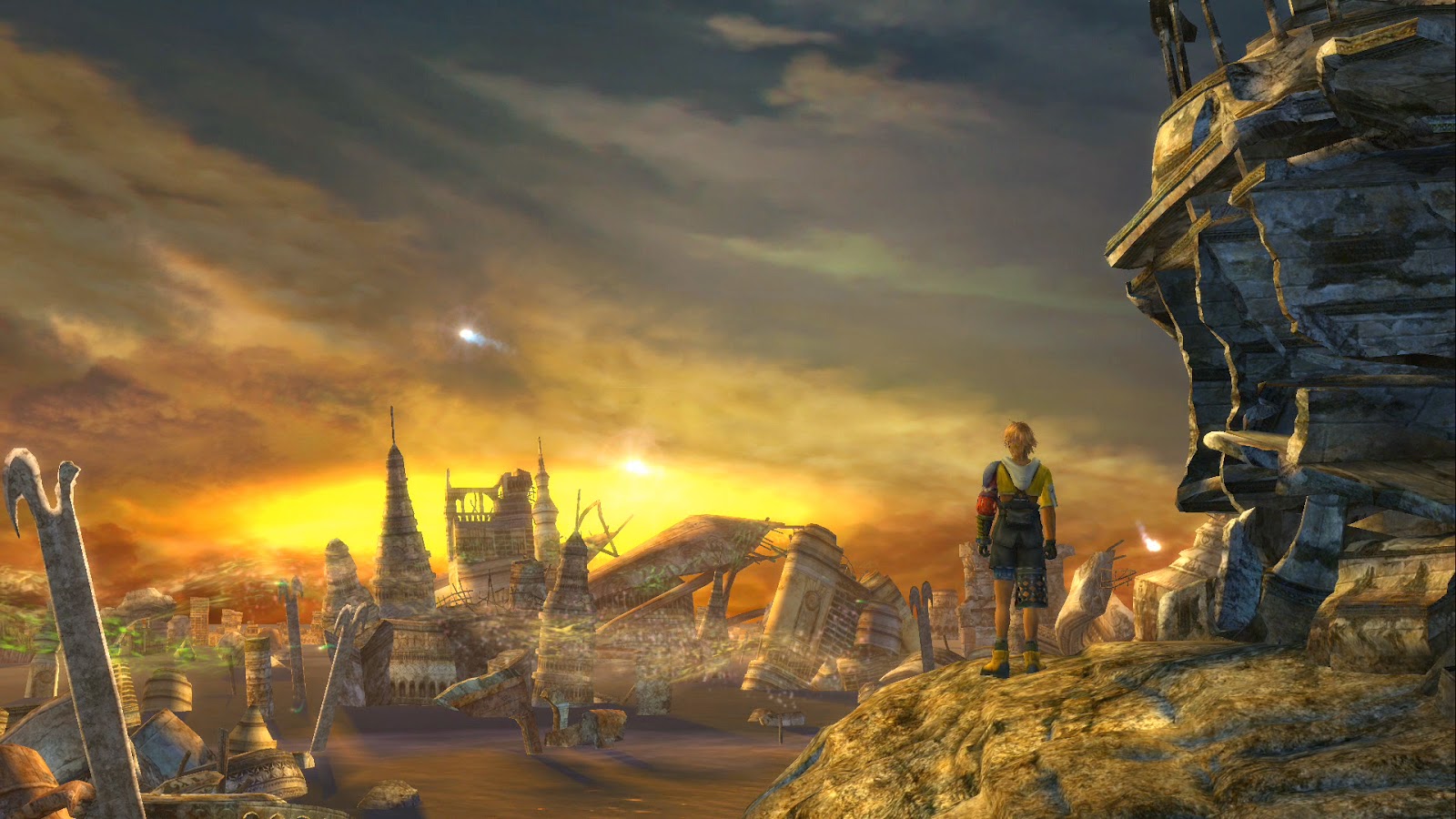
But of course the plot twist comes, turning the
long-standing dream cliché on its head. Spira is the real world. Tidus is the dream. In fact, he was born and raised in
a dream world—one that isn’t even real; one that will vanish, along with him,
eventually.
The “it was just a dream” cliché has been around for awhile,
though Alice and Wonderland did much
to popularize its presence. The scriptwriters for Final Fantasy X realized that their audience would expect Tidus’s
adventures to all be a dream as well (or at least something of the equivalent).
Cleverly, they flipped this cliché on its head, making Tidus the dream in a
real, tangible world. The plot twist is effective because it breaks a
stereotype that is shared by all storytelling mediums.
**END OF
SPOILERS**
7. Twist Reality or
Perspective

Alice in Wonderland
helped to make this plot twist rather popular, rendering Alice’s fantastical
adventures a mere dream. Today, this plot twist type is more common, and it’s
put to use often in psychological thrillers, mysteries, and sci-fi mind benders
like Inception and Shutter Island.
Two different twists of this kind can occur: (1) the
perspective twist and (2) the reality twist.
The perspective twist is best incorporated when telling a
story from the perspective of one specific viewpoint character. Because we are
limited to the POV of this single character, what he/she perceives is what we
believe. This can have mind-bending results on the readers—creating some
seriously insane plot twists—due to the isolated perspective that the audience
is given.
For example, in the novel Shutter Island **SPOILER ALERT**
the main character is sent to investigate a hospital for the criminally insane,
specifically seeking out an escaped resident. The reader believes this to be
the case because the story is told from the perspective of the main character. That’s
why readers are just as surprised as the protagonist when he discovers that he’s
actually one of the patients at the hospital himself. **END OF SPOILERS**
The reality twist has more to do with the character’s
surroundings and less to do with what goes on inside their mind. Their
perspective isn’t skewed so much as their surroundings have been morphed in
some way. The reader believes the skewed perspective, whilst the character may
or may not be aware of the truth.

A good example of this occurs in The Life of Pi, in which a boy is stranded on a boat at sea with
four animals—a zebra with an injured leg, an orangutan, a hyena, and a tiger—following
a dangerous shipwreck. **SPOILER ALERT** The story
describes the harsh experiences of the animals and boy on the boat. The hyena
kills and eats the zebra and then kills the orangutan. Later the tiger kills
the hyena and the boy is left alone on the boat with the tiger. The plot twist occurs
later when the boy, Pi, is relating his story to the Japanese Ministry of
Transport. After hearing his tale, the officials reject his story as
unbelievable. Pi then tells a second version of the story in which he is on the
boat with the ship’s cook, a Taiwanese sailor with a broken leg, and his
mother. He describes how the cook cut off the sailor’s leg for fishing bait,
later killing both the sailor and Pi’s mother for food. Pi later kills the cook
and eats him in order to survive. When asked which version of the story they
liked better, the officials chose the story with the animals. Pi simply says, “And
so it goes with God,” and the story ends, never concluding which version is the
real one. This obscured reality creates a powerful plot twist. **END
OF SPOILERS**
A Final Note on Plot
Twists
While any of these techniques can be incredibly effective in
writing a plot twist, combining two or three will achieve even better results.
If you remember nothing else, remember this: plot twists thrive on what is not
expected (what is outside the norm) and must have some form of foreshadowing in
order to be powerful and satisfying.

You may also like:


